
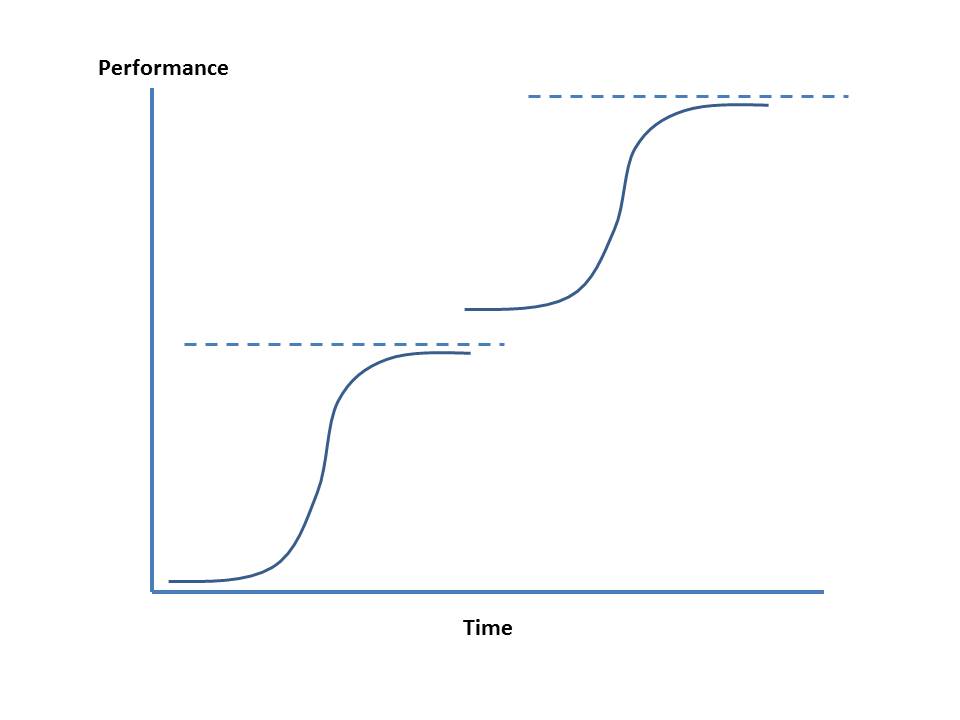
 Whitney Johnson, author of How to Build an A Team covered how an S-curve can be utilized to depict career development trajectories in a recent People and Projects podcast. This knowledge can be used to manage your own career, hone your hiring practices and optimize your team.
Briefly, the bottom of the curve is when you are new in a role and are working hard to gain knowledge and get your feet under you. This part of the curve lasts between 6 months and one year. The spot in mid-curve is when you become competent in the role. You are productive and creative in this sweet spot that lasts between 1 and 3 years. The top of the curve is when you reach mastery of your role. After a year this top point becomes a precipice in which you leap off to another S curve in a new role or it becomes a plateau you can stagnant on. The risk if you lounge too long on the plateau is that you will get pushed off. While those in mastery hold valuable corporate and tacit knowledge it is not the place where people are most productive or creative. Sometimes these masters become the “this is the way we have always done it here” person.
Johnson is a clear proponent of career disruption, advocating the strategically planned successive transition between S curves before stagnation, boredom and complacency sets in. She believes that your teams should include very few Masters – if you need someone at the top of the curve you hire a term specific consultant for that expertise. Your focus in hiring is on potential and not proficiency. This ensures your teams are optimized in terms of creativity, productivity and engagement for a longer period of time. She also reminds employers to listen to the observations of those at the lower end of the curve – they have fresh eyes and their curious questions can help highlight opportunities within your business.
As a Consultant and a Project Manager each new project brings a new S curve. The journey along the S-curve is one I am very aware of and very much enjoy. Where are you on the curve?